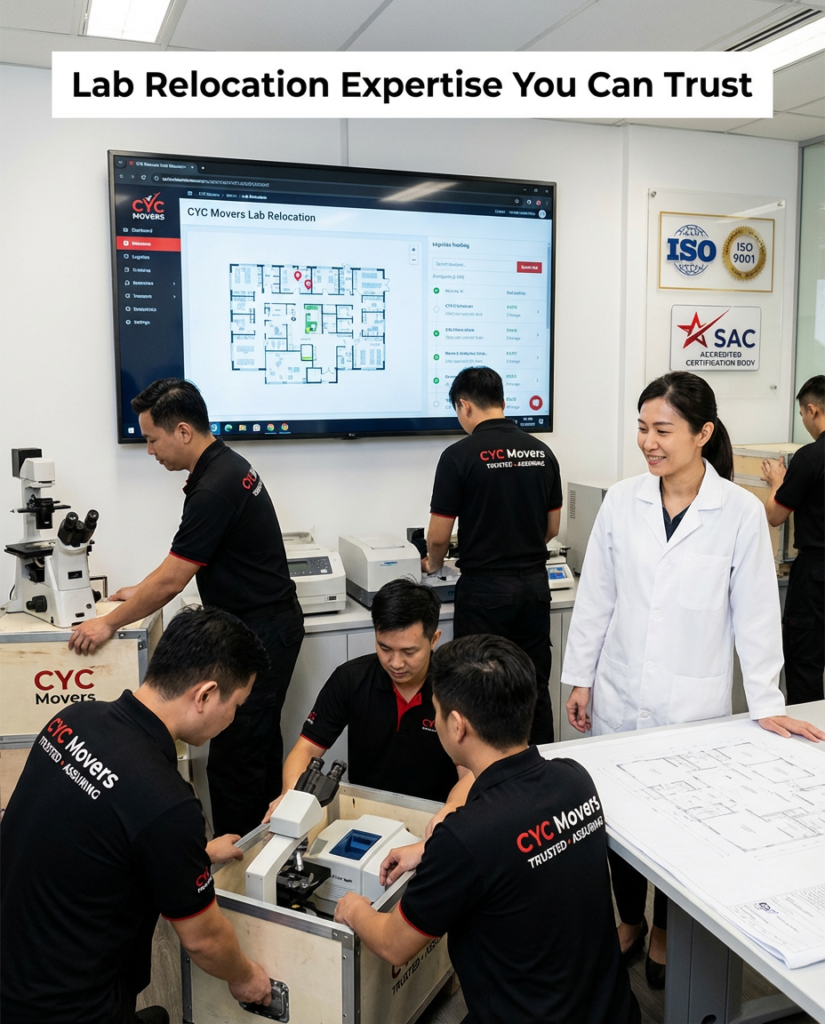
Why Data Centre Relocation Is a Board-Level Decision
A data centre relocation is not simply a facilities management project — it is a business continuity event that, if mismanaged, can result in service outages, data loss, regulatory breaches, and reputational damage. In Singapore, where digital infrastructure underpins some of Asia’s most active financial markets, healthcare systems, and government services, the stakes are extraordinarily high. The Infocomm Media Development Authority (IMDA) sets rigorous standards for critical information infrastructure resilience. Any organisation relocating its data centre needs a strategy that meets these standards and protects business continuity throughout. This guide, developed in partnership with CYC Movers’ specialist IT infrastructure team, provides a complete technical and operational roadmap.
Migration Strategy: Big Bang vs. Phased Migration
Choosing the right migration strategy is the most critical early decision in any data centre relocation:
- Big Bang (single-event migration): All infrastructure moves in one planned window, typically over a weekend or public holiday. Suitable for smaller data centres with limited dependencies, tight timelines, or facilities that are being decommissioned. Risk: all failure modes must be managed simultaneously.
- Phased migration (rolling migration): Infrastructure migrates in workload or system batches over days, weeks, or months. Each phase is independently validated before the next begins.
- Suitable for large, complex facilities with many interdependencies. Risk: parallel operations increase complexity but dramatically reduce total risk.
- Hybrid approach: Non-critical workloads move first using a phased approach, with mission-critical systems moving in a single planned window after the new facility is fully tested. This is the approach most recommended by CYC Movers for enterprise data centres.
Phase 1: Discovery and Infrastructure Mapping
Before any physical work begins, a comprehensive discovery exercise maps every component of your data centre infrastructure:
- Full rack-by-rack inventory of all servers, switches, routers, storage arrays, and PDUs
- Network dependency mapping — identifying all upstream and downstream connections for each device
- Power consumption audit — ensure the new facility has adequate UPS, cooling, and power density capacity
- Cooling requirements analysis — rack thermal density mapping for the new facility layout
- Cable plant documentation — all fibre, copper, and power cabling labelled and documented
- Software and licence inventory — confirming all licences are portable and not facility-tied
- Data classification exercise — identifying data sensitivity levels and applicable regulatory requirements
Phase 2: New Facility Preparation
The destination facility must be fully prepared before any equipment moves. This includes: rack and cabinet installation in the agreed floor layout; power infrastructure testing (UPS, PDU, branch circuit testing); cooling system commissioning and verification; fire suppression system certification; network infrastructure installation (top-of-rack switches, core routing, internet connectivity); and physical security validation. Singapore’s BCA Green Mark scheme is increasingly relevant to data centre fitout — many organisations use a relocation as an opportunity to upgrade to more energy-efficient infrastructure.
Phase 3: The Physical Move — Best Practices
- Decommission and label every cable before removal — photograph all rear-of-rack connections
- Use electrostatic discharge (ESD) protection throughout — ESD straps and anti-static bags for all components
- Transport servers horizontally where manufacturer guidelines permit — vertical transport risks hard drive damage
- Use climate-controlled vehicles with continuous temperature monitoring for sensitive storage and networking equipment
- Maintain a physical chain of custody log for every piece of equipment from rack removal to rack installation
- Deploy GPS tracking on all vehicles carrying mission-critical hardware
- Have a dedicated technical team at the destination to receive, verify, and begin installation immediately
Phase 4: Validation and Go-Live
Post-physical-move validation is where many data centre relocations fall short. A rigorous validation protocol includes: power-on testing for all devices in correct sequence; network connectivity testing from all points on the network; application-layer testing for every critical system; performance benchmarking against pre-move baselines; and a formal go/no-go decision point before traffic is cut over from the old facility. Only when all validation criteria are met should the new facility be declared operational and the old facility decommissioned.
Singapore-Specific Compliance Considerations
Data centres in Singapore handling personal data must comply with the Personal Data Protection Act (PDPA) throughout the relocation process. This includes ensuring that all data storage devices are either migrated securely or destroyed in compliance with PDPC guidelines — simply transporting a storage array containing personal data from one facility to another constitutes a data transfer that must be appropriately safeguarded. CYC Movers’ ITAD service provides certified data destruction for any decommissioned storage devices, with full documentation for your PDPA compliance records.
Frequently Asked Questions
How long does a typical data centre relocation take in Singapore?
A small server room (1–5 racks) can be relocated in a single weekend. A mid-sized enterprise data centre (10–30 racks) typically requires 2–4 weeks of phased migration. Large, complex data centres can take 3–12 months depending on the migration strategy and infrastructure complexity.
What is the most common cause of data centre relocation failures?
Inadequate pre-move discovery and mapping is the root cause of most data centre relocation failures. When teams do not fully understand all infrastructure dependencies before the move, they encounter unexpected issues during migration that cause downtime and delays.
Can we relocate a data centre without any downtime?
True zero-downtime is achievable for organisations with mature disaster recovery infrastructure that can be used to mirror workloads to the new facility before cutover. For most organisations, some planned maintenance window downtime is unavoidable, but with careful planning, this can be reduced to hours.
Does CYC Movers provide IT infrastructure relocation services for data centres in Singapore?
Yes. CYC Movers provides end-to-end IT infrastructure and data centre relocation services in Singapore, including pre-move assessment, physical migration, ITAD, and post-move support. Visit our IT infrastructure services page for details.
Learn more about our
IT infrastructure relocation services or contact us for a technical consultation.
Ready to Move? CYC Movers has been Singapore’s trusted lab relocation specialist since 2003, serving over 30,000 families, businesses, and government entities. Contact us today for a free, no-obligation quote. Get Your Free Quote →